


Childcare Isn’t a Family Benefit. It’s Workforce Infrastructure.
10/05/26
AUTHOR: Tasha Booker, President and CEO of Action for Children
I grew up in Columbus. I raised my family here. Years later, I have the privilege of leading Action for Children, central Ohio’s Child Care Resource & Referral Agency. The reason why I get to do the work I do today is because my mother made an investment in me before I was old enough to know it was happening. She sent me to a childcare program she could barely afford at $75 per week. She sacrificed her time and energy, walking me 2.5 miles to a center on Neil Avenue every day to make sure I was cared for and learning while she worked to provide for her family. She gave me an early learning foundation she believed would carry me for a lifetime.
I wouldn’t be here without it.
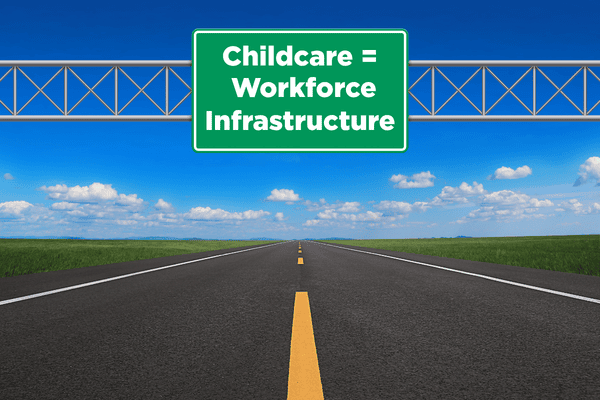
I think about that walk every time I hear childcare called a “family issue”: something parents are supposed to sort out on their own, at a kitchen table at 11 p.m. What I’ve come to believe after years in nonprofit leadership is that childcare isn’t simply a family benefit. It’s community infrastructure. And right now, Ohio is trying to run a modern economy on top of it while treating it like it’s optional.
What we actually mean by “infrastructure”
We don’t think twice about roads, broadband, or the power grid. We build them, fund them, and maintain them because we know the truth. Without them, everything else stalls. No serious employer opens a facility in a town without roads. Infrastructure is simply what lets people get to work and get things done.
Childcare does exactly that. Think about human capital. It’s arguably the most valuable resource in any economy. Human capital has to be sustained by adequate infrastructure, or it doesn’t hold up over the long run. Behind human capital is people. Families and futures. Children and learners. Early care and education professionals. Parents, working parents, business owners, entrepreneurs — people who care deeply for and about their community.
Childcare is the thing that lets those people show up. Take it away, and our most valuable resource can’t fully participate. Putting childcare on the infrastructure list (and keeping it there) shouldn’t be a debate.
The bill is already coming due for employers
Here’s the part that should get every business leader’s attention: we are already paying for this. Not in some abstract, someday way. Now.
A 2025 report from the U.S. Chamber of Commerce Foundation, the Ohio Chamber of Commerce, and Groundwork Ohio put a number on it: childcare gaps cost Ohio’s economy an estimated $5.48 billion a year.
That’s billion, with a “B”.
Of that, roughly $3.97 billion lands directly on employers, through turnover and absenteeism. Seventy percent of Ohio parents with young kids said they had missed work in just the past three months because of childcare. One in three who hit a childcare disruption left the workforce because of it.
Let those numbers sink in. We keep saying “retention problem” like it’s a mystery. It isn’t. We’re spending thousands recruiting and retraining to replace good people who didn’t want to leave. They just couldn’t find or afford care. That’s not a family failing. That’s a business cost Ohio keeps choking on.
Locally, we’re seeing the impact of this. In central Ohio, data from our 2025 Childcare Provider Survey indicated that an estimated 20,813 additional children could be enrolled in childcare if the infrastructure was present to allow programs to operate at full capacity. If filled, over $4.3 million could be added to the child care system every week.
The biggest issue? Cost for families.
What “affordable” childcare actually means
When people hear the real cost of childcare, they assume I’m exaggerating. I’m not. In Ohio, infant care runs about $17,000 a year; more than 50% higher than a year of tuition at an Ohio public university. For a family with an infant and a toddler, in care, the cost is nearly 60% more than the average rent. By the standard benchmark that care shouldn’t exceed 7% of household income, only about 8% of Ohio families can actually afford infant care. For a typical family, it swallows close to a fifth of their income.
In Franklin County, where we partner with the Franklin County Board of Commissioners and Future Ready Five to deliver Franklin County RISE, over $4.5 million dollars in childcare scholarships were distributed to families who don’t qualify for public assistance, but can’t front the cost of care on their own. But the reality is, across the seven counties Action for Children serves every day, this is a drop in the bucket — and not an available option for families outside the region.
So when a parent here does the math and decides a second paycheck won’t survive the cost of care, leaving the workforce is more often a binary choice they’re forced to make by a lack of infrastructure than a personal preference. In a 2024 Groundwork Ohio poll, 61% of parents who weren’t working full time said they would if childcare were more affordable. That’s a workforce sitting on the sidelines — ready, willing, and waiting on infrastructure we haven’t built or sustained.
But here’s where it gets complicated.
Parents need care, employers need workers, providers need to keep the lights on, the state needs a growing economy — and because it’s everybody’s problem, it’s become nobody’s job.
We end up like the Spider-Man meme, all pointing at each other, going it alone, or wasting time trying to decipher whose job it is to fix it. Meanwhile, the kids in question turn five and head to kindergarten whether we’ve sorted it out or not.
We’ve been talking about childcare for years, and I think we all know it’s an everybody problem. The trouble is it’s so big that nobody knows where to start or how to keep it going.
So let me make it smaller.
Where you can start
If you’re an employer, a civic leader, or a parent wondering what one useful thing you can do, start by understanding what already exists.
Your local Child Care Resource & Referral agency is built for a time such as this. Our job is to connect families to care and helping employers understand childcare as the workforce strategy it is. In central Ohio, that’s us. Action for Children. We’d rather have that conversation early than watch one more family or one more employer try to figure this out alone.
I won’t pretend one phone call fixes a $5 billion problem. It doesn’t. But treating childcare like the infrastructure it is starts with refusing to treat it like it’s somebody else’s job.
Our children need this infrastructure now. So do their parents, and the businesses counting on them. Let’s stop pointing fingers and instead build something sustainable, together.
“Never doubt that a small group of thoughtful, committed citizens can change the world; indeed, it’s the only thing that ever has.” – Margaret Meade